Urban Myth Dissolution Center: The Tiny-Pixel Japanese Mystery That Sold 300,000
A young woman who sees ghosts, a centre that debunks urban legends and pixel art smaller than the NES. Hakababunko's detective adventure became one of Japan's indie success stories of 2025.
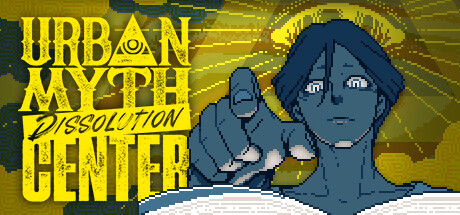
Every country has its urban legends: the cursed box, the haunted apartment, the doorway to another world. In Japan, they spread at the speed of social media. Urban Myth Dissolution Center is a detective game about investigating them, and about the strange truth that sometimes lies behind a rumour.
Developed by Japanese studio Hakababunko and published by Shueisha Games, it launched in February 2025 on Nintendo Switch, PlayStation 5 and Steam. It sold more than 300,000 units in its first three months, a strong result for a Japanese indie, and won one of the Awards for Excellence at the 2025 Japan Game Awards.
Seeing what happened
You play Azami, a young woman who can see ghosts. She soon learns that these visions are actually clairvoyance: she can see traces of past events. That makes her a perfect recruit for the Urban Myth Dissolution Center, an organisation that investigates mysteries and dismantles the legends around them.
Each case follows a satisfying loop. You gather information, including posts and chatter on a fictional social network, explore locations, use Azami's power to glimpse what really happened and then piece together the explanation. It is part ghost story and part logic puzzle, with a dry sense of humour running through it.

How a small team avoided a second nightmare
Hakababunko's previous game, Wakaidō shin no jikenbo (2020), had a troubled production that began in 2018. For Urban Myth Dissolution Center, the team set itself rules: set limits, meet deadlines and keep developing even when problems arise, rather than stopping to fix everything.
They built the game in Unity. The team started with a ready-made tool called Adventure Creator but found it too limiting, so they wrote their own social-media mode, the system that lets you browse the fictional network for clues.
The music draws on Alfred Hitchcock films and Stranger Things. One detail shows how much care went into it: one month before release, the team corrected every sound in the game after realising that the Nintendo Switch's speakers changed how the music sounded.
How it was received
Reviews were positive, especially on Nintendo's console. Urban Myth Dissolution Center scores 81 on Metacritic for Switch, 75 for PC and 71 for PS5. Nintendo World Report, Shacknews and Siliconera each gave it 9/10, Edge 7/10, Eurogamer 3 out of 5, and IGN Korea reviewed it too, with a 7/10.
The game was released in 12 languages, which helped it reach well beyond Japan. On Steam, Korean is supported for the interface and subtitles.
Why it matters
WGC's take: Urban Myth Dissolution Center is a model for small, smart Japanese indies: a distinctive premise rooted in local culture, a disciplined production process and a publisher that knows how to sell a story. Shueisha, a company best known for manga, has been building a games label, and this is one of its clearest wins.
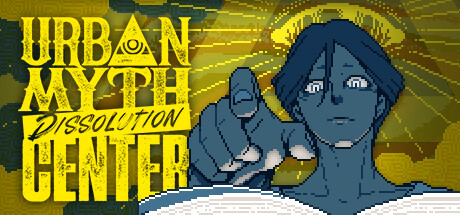
It is also a great example of constraint as style. By deliberately working at a tiny resolution, Hakababunko gave the game a look nobody else has, and made a manageable project for a small team.
Urban Myth Dissolution Center is available on Steam, PlayStation 5 and Nintendo Switch. For another Japanese indie that turned a simple idea into a phenomenon, read about The Exit 8 (here), and for puzzles of a very different kind, Blue Prince (here).