Temple Run: The Husband-and-Wife Game That Made Running Away a Genre
A tiny studio on the edge of failure, a dizzy prototype and some skull-masked monkeys. How Temple Run turned a swipe into the endless runner, and passed a billion downloads.

You grabbed the idol. Now you run. Behind you, a pack of demon monkeys in skull masks; ahead, a crumbling stone path over a bottomless drop. Swipe left at the corner, jump the gap, slide under the fire, tilt the phone to grab the coins. You will not escape. Nobody ever does.
That is Temple Run, released on iPhone on 4 August 2011 by Imangi Studios, a tiny studio run by husband-and-wife developers Keith Shepherd and Natalia Luckyanova, with art by Kiril Tchangov. With its sequel, it passed one billion downloads by June 2014, and it made the "endless runner" one of the defining genres of mobile gaming.
Born from a flop
Temple Run came out of failure. Imangi's previous game, Max Adventure, had not sold, and the studio was in trouble. Its controls, though, became the prototype for something new. The team spent about four months building Temple Run.
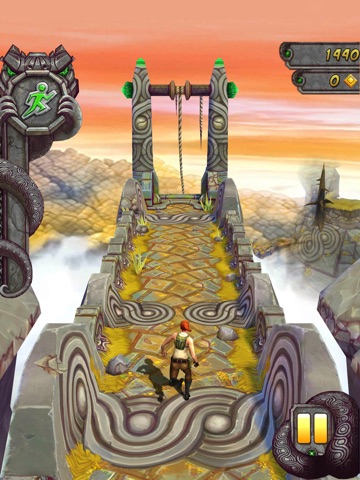
The first version had a top-down view where the whole world rotated around the player. Testers got dizzy. The fix gave Temple Run its signature: the camera stays fixed behind the runner, and the path only turns at 90 degrees, so every turn is a quick, clear swipe.
Swipe, jump, tilt
Temple Run's controls became a template for an entire genre. Swipe left or right to turn, swipe up to jump, swipe down to slide, and tilt the phone to drift sideways for coins. There is no finish line, only a score, a distance and the next attempt.
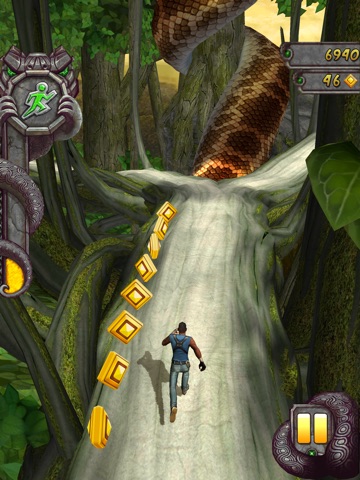
Coins buy power-ups and new characters, including adventurers such as Guy Dangerous, Scarlett Fox and Barry Bones. The temple setting drew on the Great Wall of China and Aztec temples, which gives the game its sun-bleached, ancient look.
The game launched at 99 cents and switched to free-to-play before the end of 2011, a move that sent downloads soaring. When the Android version arrived on 27 March 2012, it reached one million downloads in three days.
Temple Run 2 and the family
Temple Run 2 arrived on iOS on 16 January 2013, with smoother graphics, curving paths, zip lines and mine carts, and it soon became the main game in the series. Imangi also made licensed versions with major film studios: Temple Run: Brave, tied to Pixar's Brave, in June 2012, and Temple Run: Oz, tied to Disney's Oz the Great and Powerful, in early 2013.
The series has kept growing in new directions: Temple Run VR for Samsung Gear VR in 2014; the match-three spin-off Temple Run: Puzzle Adventure in 2021, an idle game, Temple Run: Idle Explorers, in 2023, and Temple Run: Legends in 2024, all on Apple Arcade; and Temple Run 3, launched exclusively on Android in October 2025.
Why it matters
Temple Run did not invent running games, but it defined the endless runner on phones: one-thumb controls, short, frantic runs and a high score to beat. Games such as Subway Surfers followed in its footsteps, and the genre became one of the most-downloaded on mobile.
It also proved again that a two-person team could shape the whole industry. Temple Run won a Kids' Choice Award for Favourite App in 2013, and it remains a first phone game for many children today.
Where to play
Temple Run 2 is free on iOS and Android. For more quick-session classics, see our commuter guide and the story of Flappy Bird.