Lineage 2: Revolution, the 2016 Launch That Turned Korean Phones Into MMORPG Machines
Before Lineage M, there was Netmarble's gamble: a full Unreal Engine 4 MMORPG on a phone. It made around 206 billion won in its first month and set the template every Korean mobile MMORPG still follows.
In 2016, the idea of a full MMORPG on a phone still sounded slightly mad. Korea's top mobile games were card battlers, puzzle games and action RPGs with short stages. A real MMORPG, with hundreds of players on one screen, open fields and castle sieges, was something you played on a PC in a PC bang.
Then, on December 14, 2016, Netmarble launched Lineage 2: Revolution. It took about 8 hours to reach No. 1 on Apple's App Store grossing chart in Korea, earned 7.9 billion won on its first day, a Korean mobile record at the time, and made about 206 billion won (roughly $176.6 million) in its first month. Within a year it had changed what Korean publishers thought a phone could do, and what Korean players were willing to pay for on one.
A PC legend, licensed
The name was borrowed. Lineage II was NCSOFT's 3D PC MMORPG from 2003, the sequel to the original Lineage and one of the biggest online games in Korea in the 2000s. Netmarble did not own it. It licensed the world from NCSOFT and handed it to Netmarble Neo, a studio formed from three companies, Turnon Games, Nurien Soft and Reborn Games, to rebuild for phones.
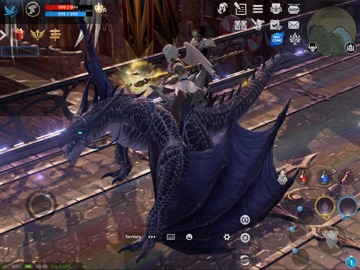
The team chose Unreal Engine 4, at the time an unusual choice for a mobile game in Korea, and aimed for something that looked like a console game: large open fields, detailed characters and big real-time battles with many players on screen.
How it played
Lineage 2: Revolution took the parts of Lineage II that mattered most to Korean players and made them work on a small screen:
- Auto-questing and auto-battle. Tap a quest and your character walks there and fights by itself. Purists hated it; busy adults loved it. It became standard in Korean mobile MMORPGs.
- Clans and castle sieges. Large-scale clan warfare, the beating heart of PC Lineage, survived the trip to mobile.
- Gear enhancement and rare drops. The economy ran on improving equipment, with paid boosts for players who wanted to move faster.
None of this was entirely new. Netmarble had already had success with Raven in 2015, a mobile action RPG. But Lineage 2: Revolution combined automation with the scale and social structure of a true MMORPG, and that combination proved incredibly profitable.
The money
The numbers were extraordinary for 2016 and 2017:
- 7.9 billion won on day one in Korea
- About 206 billion won in the first month
- No. 1 on Apple's App Store in Japan about 18 hours after its August 2017 debut there, according to reports at the time
- About $980 million worldwide in 2017, making it the seventh-highest-grossing mobile game of the year according to SuperData
- Over $1.5 billion in gross revenue worldwide by January 2019, according to Sensor Tower
- More than 30 million players by December 2018
By September 2017, Lineage 2: Revolution accounted for about 45% of Netmarble's revenue. When the company went public in May 2017, it raised about $2.4 billion, and Lineage 2: Revolution was the game everyone was talking about.
Going global
Netmarble did not stop at Korea. After its Japanese launch in 2017, the game came to the United States and Europe on November 15, 2017, backed by more than 1 million Western pre-registrations. Reviews were generally positive: TouchArcade gave it 5 out of 5, and its Metacritic score is 74. For many Western players it was their first look at what Korea meant by a mobile MMORPG.
The template it left behind
The most important thing about Lineage 2: Revolution is not what it earned, but what it taught. It showed every Korean publisher three things:
1. Players will pay for an MMORPG on a phone, and pay a lot, if it delivers the guild wars and gear chase of a PC game. 2. Automation is not a dealbreaker; for working adults it is a feature. 3. A famous PC name can turn a mobile game into an event.
NCSOFT learned the lesson fastest. Six months later, Lineage M launched and replaced Lineage 2: Revolution at the top of Korea's charts. Byline Network later noted that before Lineage M arrived, No. 1 on Google Play in Korea belonged to Lineage 2: Revolution. Then came Lineage 2M (2019), Odin: Valhalla Rising (2021), Lineage W (2021) and a long line of games critics would group together as "Lineage-likes".
The effect on the charts lasted almost a decade. When Sensor Tower reported in January 2026 that 4X strategy games had finally out-earned MMORPGs in Korea for a month, it noted that the MMORPG had been the country's top-grossing mobile genre for nine years, which takes you back almost exactly to the winter Lineage 2: Revolution arrived. Even in 2025, after years of decline, MMORPGs still took about 30% of all mobile game revenue in Korea. Few single launches anywhere have shaped a national market for that long.
Netmarble since
It is easy to forget how far Netmarble had come by then. The company was founded on March 1, 2000, growing out of a struggling developer called Ipopsoft, and spent the 2000s as a PC web-game portal, with CJ Group buying it in 2004. The money and confidence from Lineage 2: Revolution fuelled a spending spree: in 2017 Netmarble bought Kabam's Vancouver studio, and in 2019 it agreed to buy a controlling stake in Coway, a home appliance rental company, for about 1.74 trillion won.
On the games side, Netmarble has kept building on that foundation. Its later mobile hits include Ni no Kuni: Cross Worlds, the anime action game Solo Leveling: Arise (2024) and the MMORPG Raven 2 (2024), and it remains one of Korea's biggest publishers. In June 2026 it launched SOL: enchant, an MMORPG made by a team of former Lineage M developers, which topped both Korean app stores in under a day. Ten years on, the formula Lineage 2: Revolution popularised is still making money for the company that took a chance on it.
By the numbers
- December 14, 2016: Korean launch
- 8 hours: time to No. 1 on Apple's App Store in Korea
- 7.9 billion won: first-day revenue in Korea
- 206 billion won: approximate first-month revenue
- $980 million: worldwide revenue in 2017
- 30 million+: players by December 2018
What to play next
If you want to see where Lineage 2: Revolution's ideas went, start with Lineage M for the hardcore PC experience on a phone, Ni no Kuni: Cross Worlds for the same team's friendlier take, and SOL: enchant for the 2026 version of the formula, with top players helping to run their server. WGC's take: you do not have to love auto-battle MMORPGs to admit that Lineage 2: Revolution was a turning point. It is the moment Korea's PC bang generation moved into their phones, and they never really moved back.