Europa Universalis V Turns One With a Battle for the Strait of Gibraltar
Paradox's grandest strategy game hit its first birthday with a new Iberian chronicle pack and a free 1.4 update that rewires trade, religion and exploration. What changed in year one, and why EU5 already outdrew its predecessor.

Some strategy games ask you to win a war. Europa Universalis asks you to survive four centuries of them, plus plagues, reformations, bankruptcies and a succession crisis every other generation. A year ago, the series got its first new numbered entry in more than a decade.
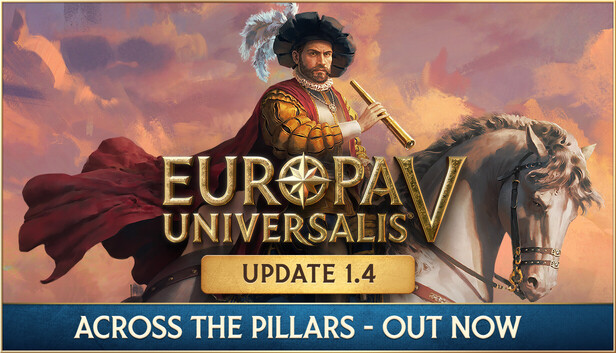
Europa Universalis V launched on November 4, 2025 on PC, developed by Paradox Tinto in Barcelona. Its first birthday came with two releases: Across the Pillars, a paid Chronicle Pack about Spain and Morocco released on October 28, 2026 for $19.99 / £16.99 / €19.99, and the free 1.4 "Rio Salado" update for everyone.
The battle for the Strait
Across the Pillars centres on a new historical Situation called The Battle of the Strait, a three-way struggle between Castile, Marinid Morocco and Granada. Whoever wins moves on to the Golden Century Situation, so the outcome shapes the next stretch of the campaign rather than just a few provinces.
The pack also adds:
- Unique expeditions: explorations, gold caravans and treasure fleets you can only launch with this pack
- New military orders for Iberian nations
- A reworked Iberian Union scenario, where you pick a centralised or federal Iberian state
- 12 Iberian and 8 Maghrebi bureaucracy options, dozens of new technologies and new historical and dynamic events
- New unit and ship models, portraits, monuments, works of art, and nine music tracks (six Castilian, three Moroccan)
What the free update changes
The 1.4 "Rio Salado" update is arguably the bigger deal, because every owner gets it. Paradox lists four main areas:
- Expeditions, a new system for exploration
- Catholicism changes, with reworked religious orders and cardinal management
- Dynastic gameplay improvements
- Major trade changes
That is a lot of systems to touch in one patch. EU5 is a game about connections: trade feeds your treasury, your treasury feeds your army, and your dynasty decides who inherits all of it. Changing trade and religion together means veteran players will need to relearn some habits.
A strong start in numbers
EU5 was the first new Europa Universalis in 12 years, and the audience showed up. On Steam it peaked at 77,320 concurrent players at launch, far above Europa Universalis IV's record of 48,165. At that point only four Paradox games had ever drawn bigger crowds: Crusader Kings II, Cities: Skylines II, Crusader Kings III and Hearts of Iron IV. Shortly before release it had about 700,000 wishlists.
Launch reviews were more mixed, at around 72% positive in the first days, with players praising the depth and scope but complaining about crashes. Paradox's year-end report for 2025 named EU5 as one of the main drivers of a 23% jump in fourth-quarter revenue, to 874.8 million Swedish kronor, but did not publish sales figures.
Who makes it
Paradox Tinto opened in June 2020 in Barcelona and is led by Johan Andersson, a long-time Paradox designer. It's one of several Paradox studios across Europe and the US, and EU5 is its first full game. The base game costs $59.99 on Steam, with a $84.99 Premium Edition that also includes Across the Pillars.
Why it matters
Grand strategy games tend to be judged in years, not weeks. EU IV became a classic over a decade of updates, and EU5 is following the same path: launch with a huge simulation, then spend years sanding the edges and adding regional depth. A year in, the pattern is clear. The free updates rework core systems, and the paid packs zoom in on specific regions. If you bounced off at launch, the 1.4 update is a reasonable time to try again. For the full story of how a Swedish board game company became the home of grand strategy, read our Paradox feature.