Sugar Crush: How Candy Crush Saga Built a $20 Billion Empire
A 2011 web game, a Facebook launch with 65 levels and a timer that made you wait half an hour. The story of the puzzle that conquered phones, and why its design is still copied everywhere.
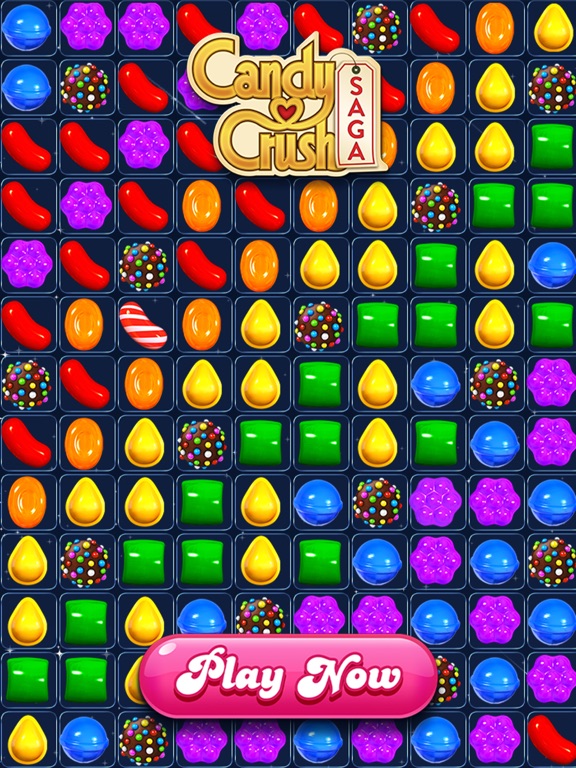
Somewhere right now, someone is on a bus, staring at a grid of jelly beans and lollipops, one move from clearing a level they have failed nine times. When it finally works, a deep voice announces "Sugar Crush!" and the board explodes into sweets. It is one of the most familiar sounds in the world.
That is Candy Crush Saga, which launched on Facebook on 12 April 2012 and on iPhone on 14 November 2012. Fourteen years later it is still among the most-played games on phones, and by September 2023 it had earned more than $20 billion in total. This is the story of how a simple matching puzzle became one of the most successful entertainment products of the century.
From a web game to a saga
Candy Crush did not invent the idea of swapping pieces to make lines of three. Its best-known ancestor is PopCap's Bejeweled, which turned "match-three" into a casual gaming staple on PCs and early phones.
The game came from King, a company founded in 2003 that built its business on quick browser games for its own website, King.com. In 2011, King made a simple web game called Candy Crush. It did well enough that the team decided to rebuild it for Facebook with one big change: instead of endless play, it would have a map of hand-designed levels, a "saga" you travelled through one stage at a time. King's co-founder and chief creative officer Sebastian Knutsson and a small team, including developer Tommy Palm, worked on the game.
The Facebook version picked up more than 4 million players within weeks. By January 2013 it had overtaken FarmVille 2 as the most-played game on Facebook. But the decisive moment was the mobile launch: iOS in November 2012 and Android in December 2012, with progress synced between Facebook and phone.
That sync mattered. You could play a few levels on your laptop at lunch and pick them up on your phone on the way home. For millions of people who would never have described themselves as gamers, Candy Crush became the game they played every single day. It also helped that the game looked friendly. Bright candy, cheerful music and a gentle learning curve made it something you could hand to a parent without explaining anything at all.
Why the levels keep you hooked
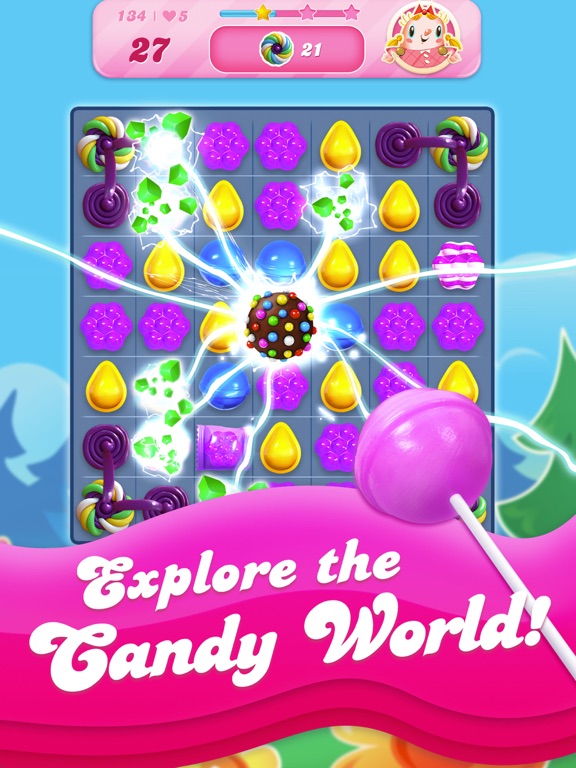
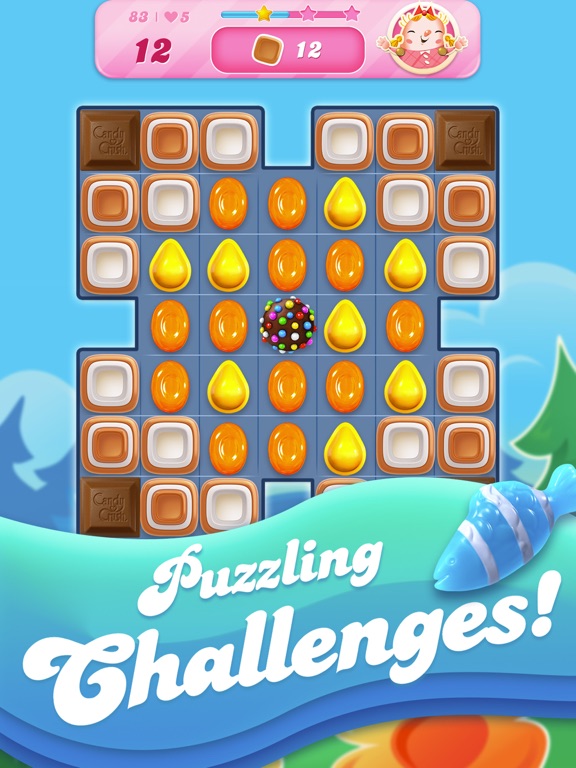
What made the saga map work was variety. Candy Crush is not one puzzle repeated thousands of times; it is many small puzzles wearing the same candy costume. Some levels ask you to clear jelly from under the pieces. Others ask you to bring ingredients, such as cherries and hazelnuts, down to the bottom of the board. Some set a score target, others a list of orders, and many add blockers such as chocolate that spreads if you ignore it.
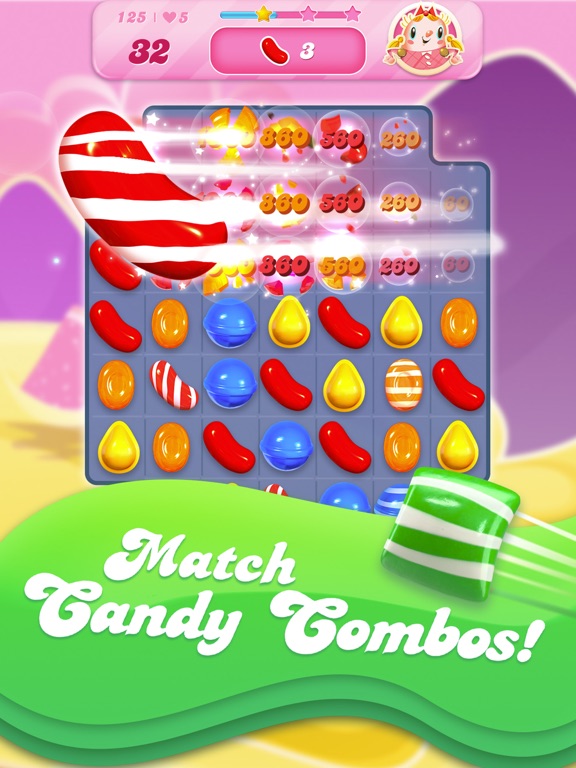
Matching four candies makes a striped candy that clears a row or column; five in an L or T shape makes a wrapped candy that explodes; five in a line makes a colour bomb. Combining two specials is where the real fireworks start. The rules can be learned in a minute, yet a hard level can take days to beat, which is exactly the balance that keeps people coming back.
The genius and controversy of five lives
The design idea that made Candy Crush famous, and that many players still grumble about, is lives. You start with five. Fail a level and you lose one. Each life comes back after half an hour. Run out, and you can wait, ask a Facebook friend to send you one, or pay.
This was not a new idea in games, but Candy Crush made it the heartbeat of the experience. It turned the game into something you visited in short bursts throughout the day rather than binged. It also created the famous flood of Facebook friend requests for lives and tickets, which some people loved and others muted forever.
Over time King relied on that model completely. The game removed ads in 2013 and earned its money almost entirely from optional purchases such as extra moves and boosters, while most players never paid at all.
Peak candy: billions of downloads and a few battles
The numbers grew huge fast. Around 2014, Candy Crush had about 245 million monthly players, and players spent more than $1.33 billion on in-app purchases that year alone. At its peak it was reported to be earning close to $1 million a day. By 2017, five years after the mobile launch, the series had passed 2.73 billion downloads.
Success also brought fights. In January 2014, it became public that King had applied to trademark the word "candy" for games, which caused an uproar among developers. King withdrew the application in February 2014. The company also sent a letter to Stoic, makers of the indie strategy game The Banner Saga, over the word "saga"; the two settled in April 2014.
From King to Activision to Microsoft
King listed its shares on the New York Stock Exchange in March 2014. Less than two years later, in February 2016, Activision Blizzard completed its purchase of King for $5.9 billion, a deal that brought the makers of Call of Duty and the makers of Candy Crush under one roof.
Then, in October 2023, Microsoft completed its $68.7 billion acquisition of Activision Blizzard. Candy Crush became a Microsoft game, and when Microsoft explained why it wanted Activision, mobile, and King in particular, was a big part of the reasoning. Microsoft had already given Candy Crush a boost years earlier by pre-installing it on new Windows 10 computers.
The family grew too: Candy Crush Soda Saga (2014), Candy Crush Jelly Saga (2016) and Candy Crush Friends Saga (2018). Since 2020, the Candy Crush All Stars tournament has offered a $1 million prize pool, and in 2024, 15 million players took part, with in-person finals in Los Angeles.
By the numbers
- 2011: the original Candy Crush web game on King.com.
- 12 April 2012: Candy Crush Saga launches on Facebook, with 65 levels.
- 14 November 2012: the iOS version arrives; Android follows in December.
- 5 lives, 30 minutes: the timer that defined a genre.
- $5.9 billion: Activision Blizzard's price for King (2016).
- $68.7 billion: Microsoft's acquisition of Activision Blizzard (2023).
- More than $20 billion: total revenue by September 2023.
Why it matters
Candy Crush showed that the biggest audience for games might be people who don't call themselves gamers. It refined a free-to-play model built on small, optional purchases rather than up-front prices, and its saga map, lives and boosters became templates copied by hundreds of puzzle games. Today's hits such as Royal Match still follow the path Candy Crush laid down. Its influence even reached Korea, where KakaoTalk's heart-sending puzzle Anipang borrowed the same social energy in 2012 (see our Anipang story).
What to play next
Candy Crush Saga is free on iOS, Android and the web. If you want a puzzle game without the lives timer, try Monument Valley or Mini Metro from our no-gacha guide.